How to Open a Hospital in India: Complete Step-by-Step Guide (2026)
Most doctors who eventually build their own hospital don't start with a business plan, they start with frustration. Years of working inside someone else's system, someone else's protocols, someone else's compromises, and at some point the question shifts from should I do this to how do I actually do this. This guide is written for that second question.
The opportunity is real, and it's backed by more than optimism. India's National Health Policy, 2017 recommends two hospital beds per 1,000 population as a baseline, yet government data placed the country's public hospital bed availability at roughly 0.79 beds per 1,000 people as of March 2023, a gap the Ministry of Health and Family Welfare itself has acknowledged in Parliament. That shortfall doesn't close on its own. It closes through hospitals that get built properly, by people who understand both medicine and the machinery of running an institution.
This isn't a small-clinic conversation, though. A hospital touches company law, labour law, environmental law, and medical regulation all at once, and doctors who try to treat it like an oversized clinic tend to lose months to avoidable mistakes. If you'd rather have someone walk the regulatory maze with you, Hospital Consulting Noida is built exactly for that, physicians bring the clinical vision, and the rest gets handled in parallel rather than learned the hard way.
Healthcare Infrastructure in India: Why the Market Favours Doctor-Led Hospitals
Before getting into licenses and paperwork, it helps to understand why this path makes sense in the first place. The numbers on healthcare infrastructure explain the opportunity better than any pitch deck could.
The Structural Gap in India's Healthcare Infrastructure
India's healthcare demand isn't evenly distributed, and neither is its supply. Private hospitals fill a large share of the gap left by under-resourced public healthcare infrastructure, particularly in secondary and tertiary care. The Indian Public Health Standards, revised in 2022, recommend a baseline of one bed per 1,000 population as a minimum planning target, a benchmark large parts of the country still haven't reached. For a doctor evaluating where to build a healthcare facility, that gap is the market.
Government Programs Every Hospital Entrepreneur Should Know
Ayushman Bharat, the government's flagship health protection scheme, which expands the pool of patients whose treatment costs are covered through empanelled hospitals
Ayushman Bharat Digital Mission, pushing hospitals toward electronic health records and interoperable patient data
Pradhan Mantri Ayushman Bharat Health Infrastructure Mission, central funding aimed at strengthening health infrastructure at district and sub-district levels
None of these hand a doctor a hospital. But they shape what patients expect, what insurers reimburse, and what a competitive healthcare facility eventually needs to offer.
Step 1: Business Registration and Legal Structure for Your Hospital
Every hospital entrepreneur has to make a foundational decision before touching medical licensing: what legal entity will actually own and run the facility. Get this wrong, and healthcare compliance gets harder at every later stage.
Choosing the Right Business Structure
A hospital needs to exist as a legal entity before it can hold a single license. Most founders register as a Private Limited Company under the Companies Act, 2013, largely because it offers limited liability and makes it easier to bring in investors or partners later, though Trusts, Societies, and LLPs remain common, especially for smaller or not-for-profit setups.
Registering Your Company with the Ministry of Corporate Affairs
This registration runs through the Ministry of Corporate Affairs (MCA). Practically, that means obtaining a Digital Signature Certificate and Director Identification Number for each director or promoter, reserving a company name, and filing incorporation documents through the MCA's SPICe+ portal to receive a Certificate of Incorporation. PAN and TAN follow soon after, since the entity will need both for banking, GST registration, and TDS obligations on payments to doctors and staff.
Doctors setting up in Delhi NCR often find this is where things quietly go wrong, not because MCA registration is difficult, but because a structure chosen without healthcare licensing in mind creates friction later. Hospital Consulting Delhi NCR advisors tend to get involved right here, before the paperwork compounds.
Step 2: Hospital Registration Process Under the Clinical Establishments Act
Business registration alone doesn't make a facility a hospital. This next step is healthcare-specific, and it's the one most doctors underestimate going in.
Clinical Establishment Licensing: What the Law Requires
The Clinical Establishments (Registration and Regulation) Act, 2010 is the central legislation governing registration of hospitals, nursing homes, clinics, and diagnostic centres. It has been adopted by 19 states and Union Territories, including Uttar Pradesh, while some states, Delhi among them, continue to regulate clinical establishments under their own separate frameworks instead. Under the Act, state governments constitute registering authorities, typically involving the District Health Officer or Chief Medical Officer, and applicants must meet minimum facility and staffing standards before registration, first provisional, then permanent, is granted.
Registering a Hospital in Noida and Uttar Pradesh
For a hospital opening in Noida, this means working directly with the State Health Department and District Health Authority under Uttar Pradesh's adoption of the central Act. Getting the application complete on the first submission matters more than people expect; resubmissions cost real time. This is a large part of why Healthcare Management Consulting Noida support exists, not to replace the doctor's judgment, but to keep the paperwork from becoming the bottleneck.
Step 3: Medical Licensing and Regulatory Approvals to Run in Parallel
Clinical establishment registration doesn't happen in isolation. Several other medical licensing and compliance approvals need to move at the same time, each from a different authority.
Biomedical waste authorization: Under the Bio-Medical Waste Management Rules, 2016, notified by the Ministry of Environment, Forest and Climate Change (MoEFCC), every waste-generating healthcare facility needs authorization from the State Pollution Control Board, along with colour-coded segregation systems and annual compliance reporting to the CPCB.
Fire and building safety NOC, issued by the local fire department based on the building's layout, exits, and evacuation planning.
Radiation safety clearance, required from the Atomic Energy Regulatory Board for hospitals running radiology, CT, or other imaging departments.
Drug licensing, needed if the hospital runs an in-house pharmacy, regulated jointly by the Central Drugs Standard Control Organization (CDSCO) and state drug control authorities.
Labour and employee welfare registrations, EPFO and ESIC registrations under the Ministry of Labour and Employment become mandatory once staff strength crosses prescribed thresholds.
GST registration, mandatory for most healthcare service entities operating at scale.
Treat these as one coordinated project rather than a sequence of separate errands. A hospital that gets its fire NOC but stalls on biomedical waste authorization still can't legally admit patients.
Step 4: NABH Accreditation and Healthcare Quality Standards
Licensing gets a hospital open. Accreditation is what makes patients, insurers, and referring doctors trust it once it is. This step is optional on paper but increasingly non-negotiable in practice.
What NABH Accreditation Actually Involves
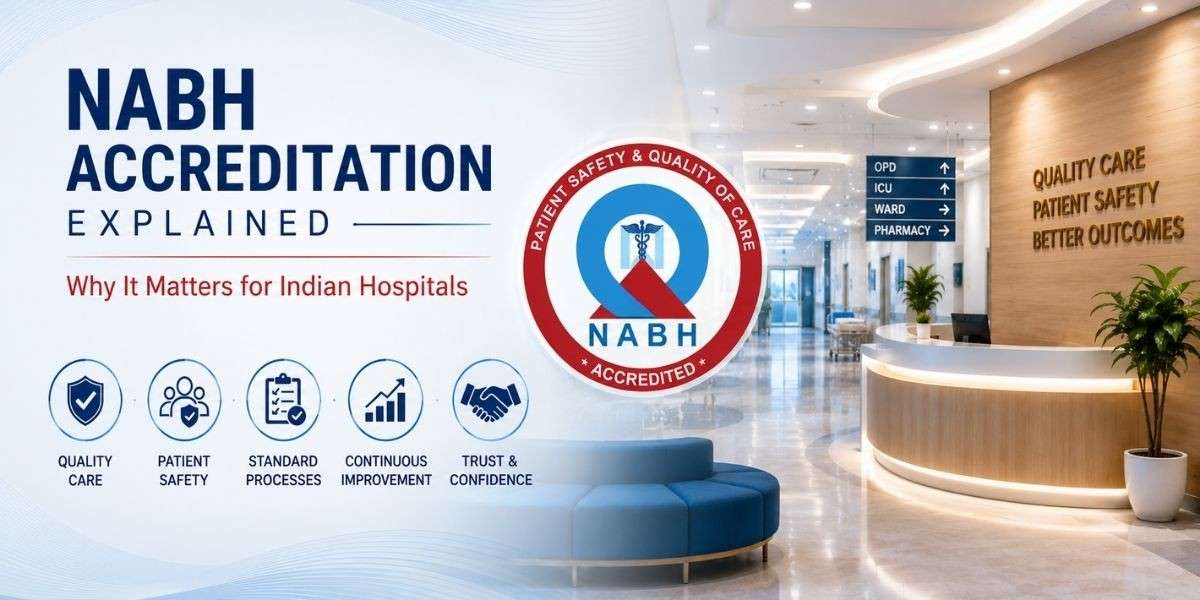
NABH accreditation isn't a legal requirement for most hospitals, but it has become close to an operational expectation. The National Accreditation Board for Hospitals & Healthcare Providers, a constituent board of the Quality Council of India, evaluates hospitals against detailed patient-safety and healthcare quality standards, and its accreditation carries international recognition through ISQua. Insurers increasingly favour impanelling accredited facilities, and patients, especially in urban markets, have started to check for it before choosing where to be treated.
The mistake most first-time hospital owners make is treating NABH preparation as something to start after opening. It's far less painful to build documentation, protocols, and quality processes into the healthcare facility from day one than to retrofit them onto an already-running hospital.
Step 5: Hospital Business Plan, Location, and Funding
A medical licence alone doesn't make a hospital viable; it has to work as a business too. This is where clinical judgment and commercial planning need to sit at the same table.
Location and Demographics
A hospital's location decision should weigh population density, age profile, existing competition, and, just as importantly, accessibility for ambulances and patients in genuine emergencies. A clinically excellent healthcare facility tucked down an unmarked lane loses patients it should have kept.
Financial Planning for Your Hospital Business Plan
Capital requirements scale sharply with bed strength, specialty mix, and equipment intensity, and they vary widely by city and land cost, which is exactly why doctors should build their own project-specific estimate rather than lean on generic industry figures that rarely match local reality. What matters more than any single number is discipline: realistic land and construction costs, honest equipment budgeting, a properly sized working capital cushion, and contingency for licensing delays that are more common than founders expect.
Funding Routes for Hospital Entrepreneurs
Healthcare-sector lending is available through nationalized and private banks, and government-backed credit schemes exist for smaller ventures and for women entrepreneurs specifically. Larger projects sometimes attract private equity or healthcare-focused investors. Whichever route a doctor chooses, lenders and investors alike will want to see the clinical establishment registration pathway mapped out clearly; funding tends to follow regulatory clarity, not the other way around.
Step 6: Medical Infrastructure Requirements and Equipment Planning
Once the business plan is settled, attention shifts to the physical hospital itself. Infrastructure decisions made now are expensive to reverse once construction is complete.
Space and Facility Standards
Indian Public Health Standards and NABH documentation both give detailed guidance on space allocation for wards, ICUs, operation theatres, and emergency areas; ventilation, power backup, and medical gas pipeline requirements differ meaningfully between a general ward and an ICU, and getting these wrong is expensive to fix after construction.
Medical Equipment Planning
Equipment planning should follow clinical strategy, not the reverse. A hospital built around orthopedics needs different diagnostic and surgical infrastructure than one built around maternity or general medicine. Overbuying imaging equipment just in case ties up capital that could otherwise stabilize the first two years of operations, arguably the period most new hospitals actually struggle through.
Step 7: Healthcare Staffing and Hospital Management Systems
A hospital is only as reliable as the people and systems running it day to day. Staffing and technology decisions here directly shape patient care services down the line.
Medical Staffing and Registration Requirements
Every doctor practising at the hospital needs valid medical licensing, tracked through the National Medical Register maintained by the National Medical Commission (NMC) under Section 31 of the NMC Act, 2019, a digital, Aadhaar-linked database covering all registered allopathic practitioners in India. Nursing staff, pharmacists, and administrative teams bring their own qualification and registration requirements, and healthcare compliance extends well beyond doctors alone.
Choosing a Hospital Management System
Most functioning hospitals today run on some form of hospital management system tying together registration, billing, pharmacy, and bed management. It's not glamorous infrastructure, but running a modern healthcare facility without one creates operational drag that shows up in patient wait times and billing errors long before it shows up on a balance sheet.
Step 8: Patient Trust, Insurance Empanelment, and Patient Care Services
Even a fully licensed, well-staffed hospital needs patients to actually choose it. Trust-building starts before opening day, not after.
Building Credibility Before Opening Day
Marketing a hospital isn't advertising in the traditional sense; it's demonstrating credibility. Community health camps, partnerships with local doctors for referrals, and a clear, accurate digital presence (a real website, an accurate Google Business listing, doctor credentials that are actually verifiable) do more for a new hospital's reputation than any campaign. Patients researching a hospital today expect to find doctors, services, and accreditation status clearly listed, and they notice when it isn't.
Insurance and Government Scheme Empanelment
Insurance and government scheme empanelment, Ayushman Bharat, CGHS, ESIC, and private insurers, also shape patient flow substantially, and each has its own empanelment process worth starting early rather than after the hospital is already operational.
Step 9: Ongoing Healthcare Compliance After Opening
Getting licensed is the beginning, not the finish line. Compliance is a recurring obligation, not a box you tick once and forget.
Building a Compliance Calendar
Biomedical waste reporting, staff credential renewals, periodic NABH reassessment for accredited hospitals, and continued alignment with State Health Department inspections all repeat on their own schedules. A compliance calendar, tracked as seriously as the appointment book, prevents the kind of late renewal that quietly shuts down operations for a few costly days.
Common Pitfalls Worth Naming
A few mistakes show up again and again in new hospital projects: underestimating how long licensing genuinely takes, choosing a legal structure before understanding its licensing implications, over-investing in equipment before validating patient volume, and treating NABH preparation as an afterthought rather than a design principle from day one. None of these are complicated to avoid; they just require sequencing the project correctly, which is easier with someone who has done it before.
Also Read: How to Open a Clinic in Dubai in 2026: First Steps Every Investor Must Know
Where Nexa Health Consult Fits In
Doctors are trained to diagnose and treat, not to interpret clinical establishment rules or negotiate biomedical waste authorization timelines, and there's no reason they should have to become experts in both. Nexa Health Consult works alongside physician-entrepreneurs through exactly this stretch of the journey: legal structuring, licensing sequencing, NABH readiness, and the operational planning that turns a good clinical idea into a functioning hospital. The clinical vision stays the doctor's. The regulatory and operational groundwork is where outside expertise earns its place.
Final Thoughts: Building a Successful Hospital in India
Starting a hospital as a doctor means managing two responsibilities at the same time: a clinician and a founder. The journey requires patience, careful decision-making, and a clear understanding that building a healthcare institution takes more than medical expertise alone. Get the legal structure right before challenges arise, treat clinical establishment registration and NABH preparation as strategic decisions rather than simple paperwork, and create financial plans based on your specific hospital vision instead of relying on generic industry assumptions.
With the right planning, expert guidance, and a structured approach, the journey from doctor to hospital owner becomes far more achievable. Nexa Health Consult helps doctors and healthcare entrepreneurs navigate hospital planning, compliance, infrastructure strategy, and operational setup with professional healthcare consulting support.
Planning to start your own hospital? Contact Nexa Health Consult today to discuss your hospital project and get expert guidance for building a future-ready healthcare facility.
Frequently Asked Questions About Opening a Hospital in India
Can a single doctor legally open a hospital in India, or are multiple partners required? A single doctor can open a hospital under the right legal structure, though many choose to bring in partners for shared capital, diverse specialties, and a wider referral network. There's no regulatory requirement forcing multiple owners; it's a business decision, not a legal one.
Is NABH accreditation mandatory to operate a hospital?
No. NABH accreditation is voluntary in most cases, but it has become an important credibility marker for insurers and patients, and many hospitals pursue it soon after opening rather than treating it as optional forever.
Which government body handles hospital registration?
Clinical establishment registration is handled at the state level, typically by the State Health Department or District Health Authority, under the Clinical Establishments (Registration and Regulation) Act, 2010, in states that have adopted it, including Uttar Pradesh.
Do doctors need separate registration to practise inside their own hospital?
Yes. Every practising doctor, including the hospital's founder, must be registered on the National Medical Register maintained by the National Medical Commission, regardless of hospital ownership status.
How long does the overall setup process typically take?
It varies significantly by project scope, location, and how quickly state-level approvals move, but licensing and registration phases alone commonly span several months. Starting the regulatory process early, in parallel with construction and hiring, not after, is what keeps timelines realistic.